
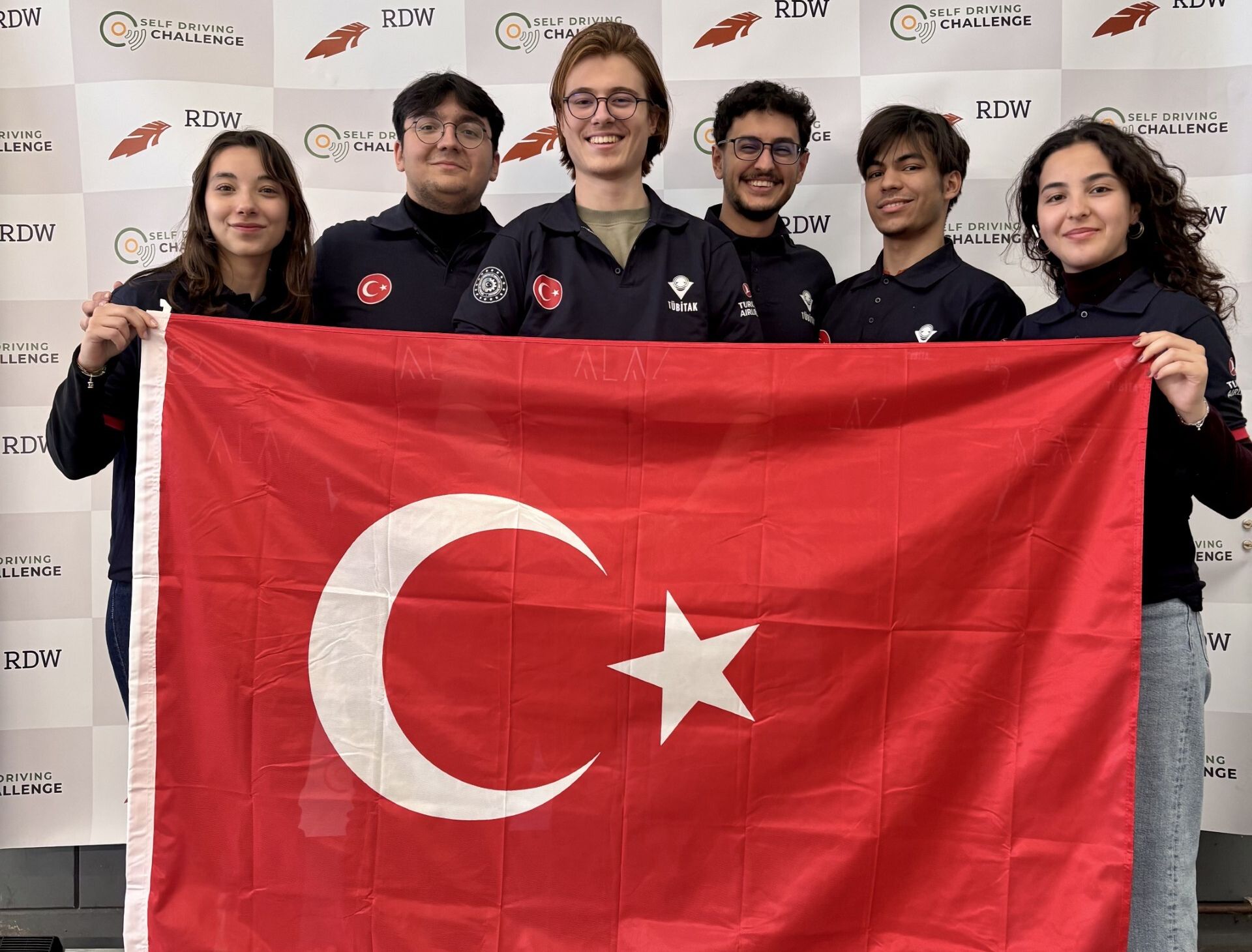
Team Alaz
At the RDW Self Driving Challenge, Team Alaz from Middle East Technical University is ready to showcase its work on an international level. With a strong sense of pride and ambition, the team is not only representing their university, but also their country: Turkey.
Their participation is driven by the desire to put their knowledge into practice and to test themselves in a competitive, international environment.
A multidisciplinary team with a big vision
Team Alaz consists of six software engineers, each specializing in different layers of the autonomous driving stack, while maintaining a system-wide understanding. They are supported by a finance and PR member who manages sponsorships and public visibility.
Beyond the competition team, their broader group also includes electronics and mechanical engineers who are building a fully custom vehicle from scratch in their workshop in Turkey. This broader effort highlights their long-term commitment to autonomous driving.
A field full of opportunity
For Team Alaz, autonomous driving is a rapidly evolving field with enormous potential. The lack of fully standardized solutions makes it a dynamic space where innovation is still wide open.
Designing systems that can perceive, decide and act independently is both technically challenging and deeply motivating, making it an ideal field for ambitious engineering students.
How their system works
Their self-driving system uses camera data and speed sensors to determine the vehicle’s position on the track. Through a combination of sensor fusion and visual SLAM, the system estimates where the vehicle is within its environment.
A mission planner then sets the target, while a planning system generates a path that takes both static and dynamic obstacles into account. Finally, the controller executes the commands needed to steer, accelerate and brake along that path.
Focus on smart and reliable architecture
For this challenge, Team Alaz is focusing on building a robust system architecture centered around localization, planning and control.
Because their system relies on a limited set of sensors, they place strong emphasis on sensor fusion and visual SLAM to achieve accurate localization. At the same time, they are developing planning algorithms that can safely handle dynamic environments.
Their goal is to create a system that is not only functional, but also reliable under real competition conditions.
The challenge of knowing where you are
One of the biggest challenges the team expects is localization. Without access to GPS, the vehicle must rely entirely on onboard sensors to determine its position.
Accurate localization is critical for every part of the system, making it one of the most important and demanding aspects of their approach.
Learning through international experience
Through this challenge, Team Alaz aims to gain hands-on experience in building autonomous systems with limited sensor resources. They also see this as an opportunity to grow both technically and as a team.
Equally important is the experience of competing internationally, learning from other teams and representing their university and country with pride.
Intelligent, agile and principled
If they had to describe themselves in three words, Team Alaz chooses intelligent, agile and principled. With that mindset, they enter the challenge with confidence and determination.
Ready and proud
Team Alaz is excited, proud and honored to be part of the competition. As they take on this challenge, they also wish all other teams the very best of luck.