
Hanzehogeschool Groningen
Hanze
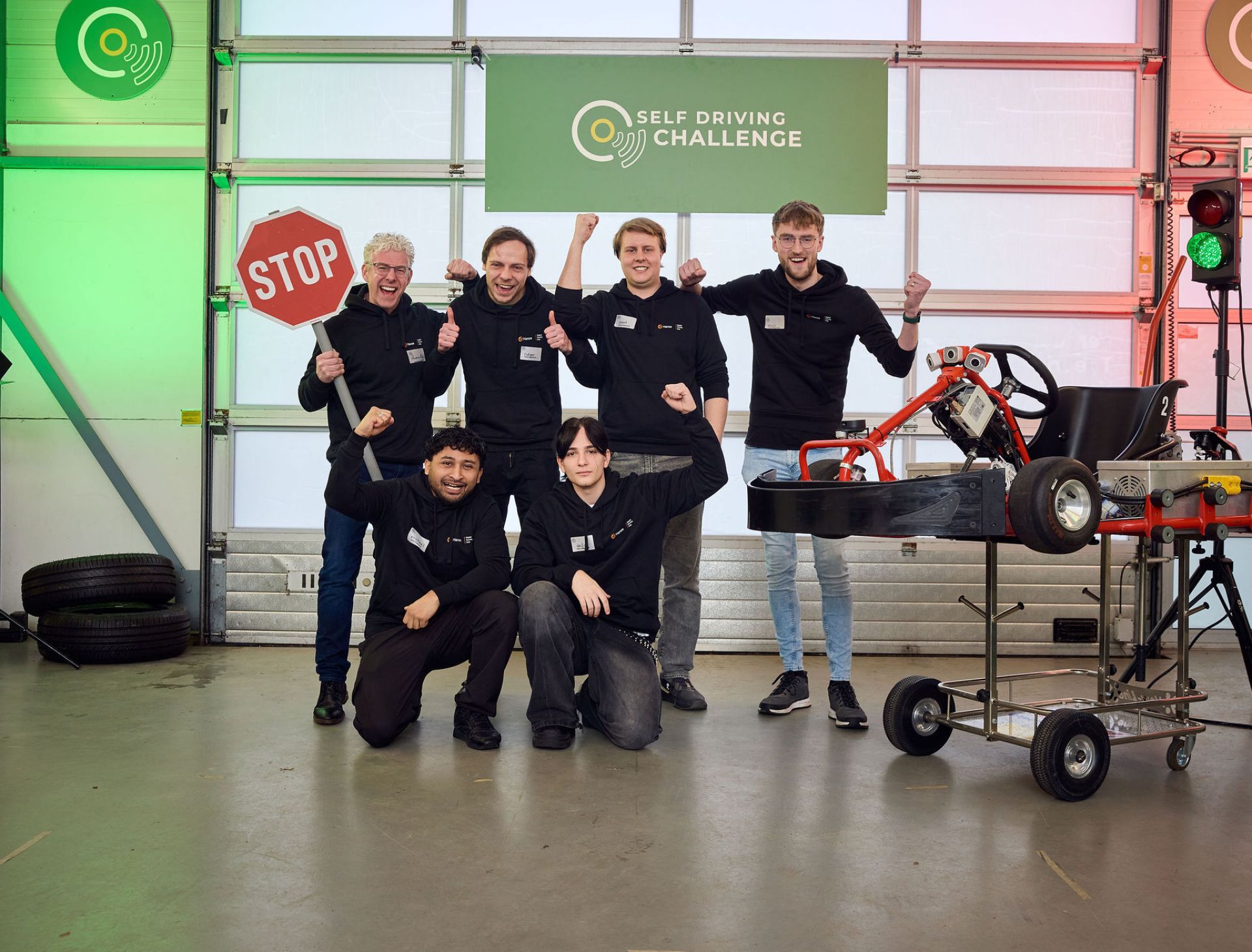
At the RDW Self Driving Challenge, Team Hanze is turning theory into reality. This driven group of students from the Hanze University of Applied Sciences is tackling one of the most exciting challenges in tech today: building a self-driving vehicle that can understand and navigate the real world.
From classroom to real world innovation
The team is no stranger to success. Last year, they claimed victory in the closed category, setting the bar high for this year’s competition. With that achievement under their belt, they return with even more experience and ambition.
The team consists mainly of software engineers, supported by a specialist in network and security. Together, they form a strong and versatile unit that covers everything from hardware communication to advanced software development.
Where AI meets the real world
What drew them to the challenge was not just artificial intelligence or machine learning on their own, but the opportunity to apply these technologies in a physical setting. For Team Hanze, the real excitement lies in seeing their code come to life on an actual vehicle.
At the core of their project is a fundamental question: how can a vehicle interpret its surroundings and act on it in real time? Translating the complexity of the real world into meaningful decisions is what drives the team forward.
How their system works
Their system relies on cameras to detect and recognise objects around the vehicle. To make development more efficient, the team trained their recognition model in a simulation environment. This allows them to continuously improve their system beyond the limited time available during testing days.
Once the vehicle is running, it constantly scans its environment and uses that information to make decisions in real time.
Combining sensors for better decisions
To take things a step further, Team Hanze is focusing on sensor fusion. By combining camera input with LiDAR data, they aim to create a more reliable and complete understanding of the environment. This approach increases accuracy and helps the vehicle respond more effectively to complex situations.
Facing real world challenges
The team knows that the real world will bring its own challenges. While simulations and test environments offer controlled conditions, the competition track is far less predictable. Changing lighting conditions, varying track surfaces and unexpected object placement will all test the robustness of their system.
Learning by doing
For Team Hanze, this challenge is about more than just performance. It is a learning experience. They want to deepen their knowledge of AI and machine learning while gaining hands-on experience with hardware systems.
As they put it, there is a big difference between something that works on paper and something that performs reliably in reality.
Ready for the challenge
Curious, driven and hands-on, and with a title to defend, Team Hanze is ready to put their work to the test. Whatever the outcome, they are here to learn, push boundaries and make the most of this unique experience.
